
Start with the free part
Termites need moisture, a hidden route and wood. Take away any one and a house becomes a much less likely target. Most of what follows costs a Saturday and a trip to the hardware store.
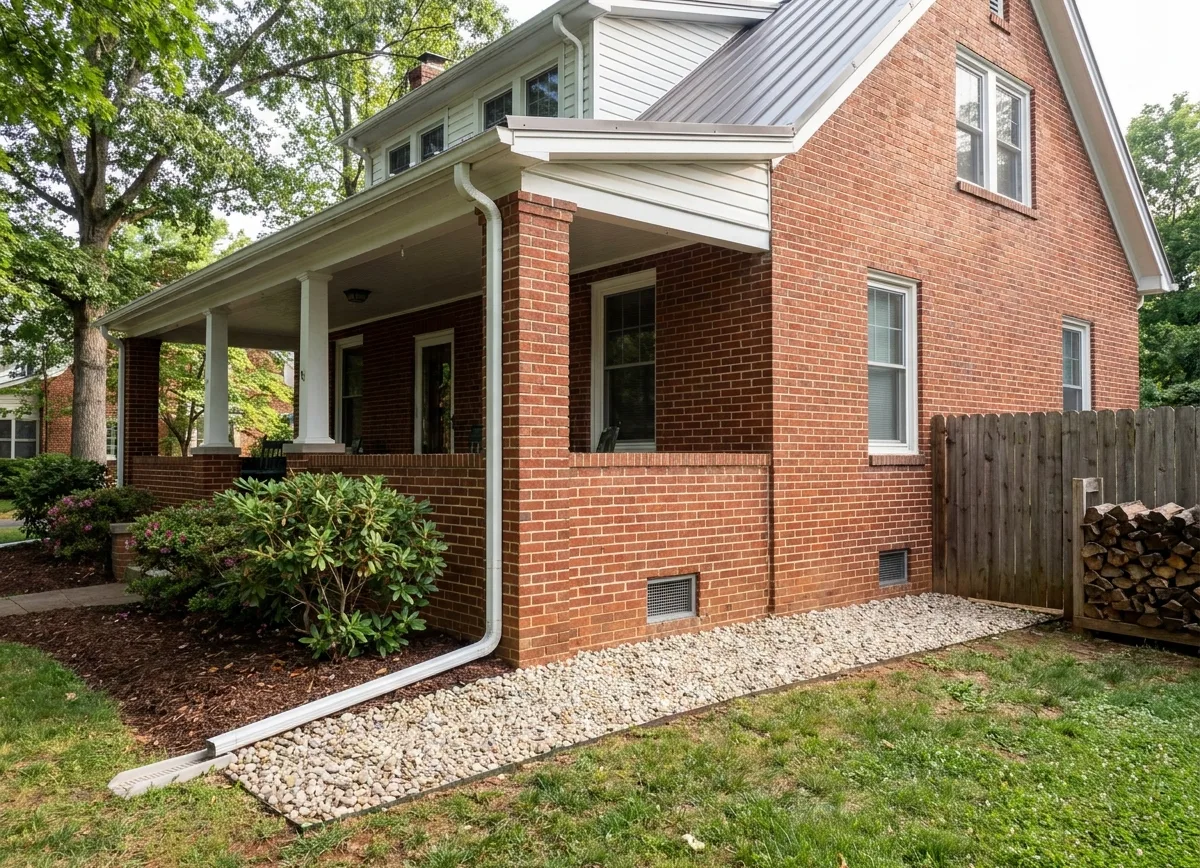
- Keep six inches of foundation showing. Soil and mulch should stop well short of the siding or the brick ledge, so a mud tube has to cross open masonry where it can be seen.
- Send roof water away. Extend downspouts several feet from the wall and clean the gutters before the autumn leaf drop and again after it. A corner that stays wet is where we most often find the first tube.
- Break wood-to-ground contact. Deck posts on metal standoffs, lattice trimmed clear of the dirt, stair stringers on a concrete pad, fence rails not fastened into the house.
- Dry the crawl space. A continuous vapor barrier over the soil, vents free of leaves and shrubs, and plumbing leaks fixed promptly.
- Move the woodpile. Firewood belongs on a rack, off the ground and away from the house, not stacked on the porch from October to March.
- Deal with stumps. An oak stump ten feet from the foundation can feed a colony for a decade. Grinding it out removes a reason for termites to be in that part of the yard.
Then decide how much protection to add
| Level | What is done | Best suited to |
|---|---|---|
| Inspect yearly | A full inspection every twelve months and the habits above | Newer houses on dry lots with open, visible foundations |
| Monitor | Ground stations and fixed checkpoints read several times a year | Houses near woods, or with a foundation that is hard to see |
| Preventive bait | Active bait stations installed and serviced even though no termites have been found | Slab homes and finished basements where an inspection can only see so much |
| Preventive soil treatment | A treated zone around the whole foundation | Older houses on crawl spaces, and any house whose neighbours have been treated for termites |
| Borate on framing | Bare joists and sills sprayed so the wood itself resists attack | Crawl spaces being encapsulated, and renovations with framing exposed |
These stack. A common combination on a 1940s house off Rugby Avenue is a soil treatment now, borate while the crawl space is open, and an inspection every year after.
Does every house need a preventive treatment?
No, and you should be sceptical of anyone who says so. A ten-year-old house on a well-drained lot, with a visible foundation and a builder’s treatment certificate still on file, is reasonably served by a yearly inspection. We would rather tell you that than sell you chemistry the house does not need.
The balance shifts when several risk factors pile up. When C’ville Termite Removal Experts weighs up a property, these are the things that move a recommendation toward treating:
- A crawl space that stays damp, or one too low to inspect properly.
- Termite treatment or damage disclosed by a previous owner.
- Foam insulation, stone veneer or stucco running below grade, all of which hide tubes.
- Woods, a creek or a long-neglected lot along the property line.
- An addition, porch or sunroom on its own footing.
The best time to do it
Any time before termites arrive, which in practice means now rather than after the next swarm. Two moments are especially good: just after buying a house, when you have a fresh inspection report and nothing stored in the crawl space yet, and during any project that opens the ground or the framing, such as a new patio, drainage work or a kitchen renovation.
Prevention has to be maintained. A soil treatment is disturbed by digging, a bait system only works while it is serviced, and mulch creeps back up the wall within a couple of seasons. Put the yearly check on the calendar.
Building new or adding on? Protection is simplest before the concrete is poured; see termite barrier installation. For a house with no protection and no known history, a termite inspection is the place to begin.