
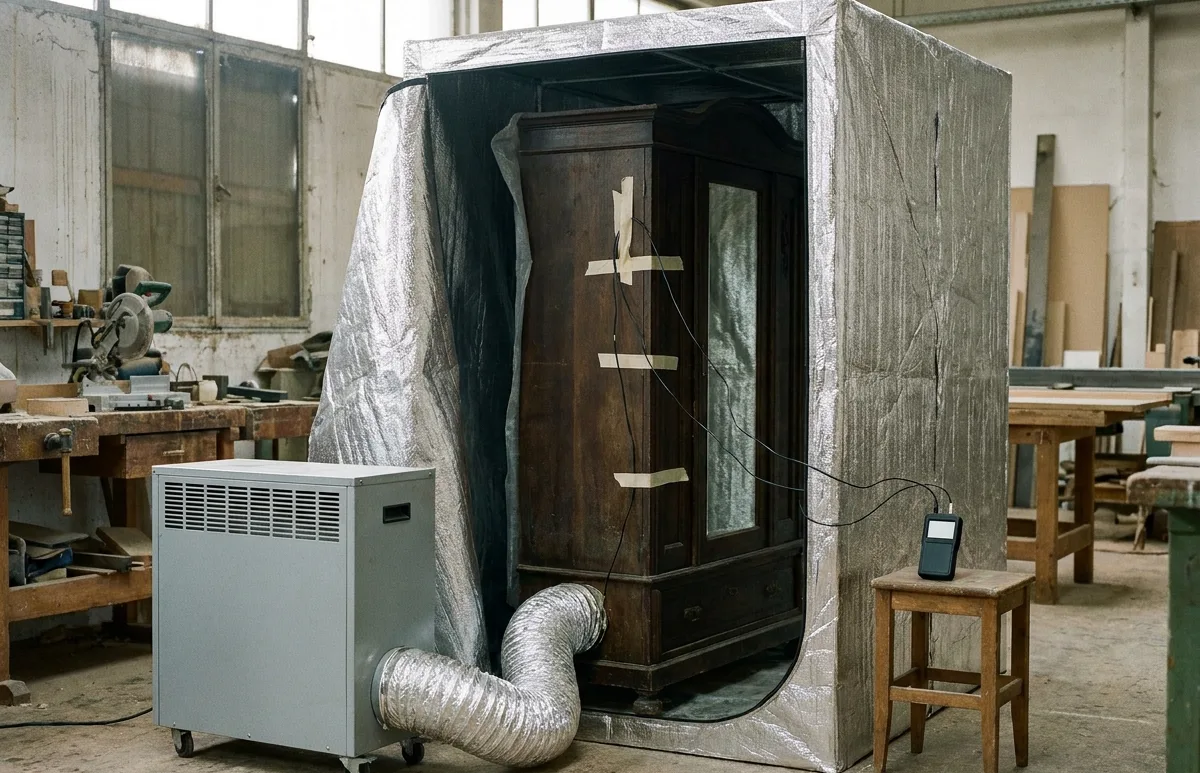
How heat kills wood-infesting insects
Insects cannot regulate their body temperature. Once the wood around them passes roughly 120°F they begin to die, and the working target for a treatment is higher than that, around 130°F measured at the centre of the thickest piece, held for an hour or longer. Air temperature in the enclosure runs hotter still, because timber is a good insulator and the core lags well behind the surface.
That lag is the whole skill of the job. Probes are placed inside drilled test blocks or pressed into joints at the coldest points, and the clock does not start until the slowest probe reaches the target. Heating by the air temperature alone is how treatments fail.
Where heat works well
- Furniture carrying drywood termites. Pieces brought up from the coast or bought at auction sometimes arrive with a small colony inside. The whole item is enclosed and heated, and it goes back into the house the same day.
- Powderpost beetles in boards and beams. Reclaimed barn siding, antique flooring, mantel beams and rough-sawn hardwood are common carriers. Heating the stack before it is installed is far easier than chasing beetles through a finished room.
- An isolated section of framing. A single infested attic rafter bay or a window header can be tented in place with insulated panels and treated on its own.
- Households avoiding pesticides. For clients with chemical sensitivities, or pieces going into a nursery, heat does the job with nothing applied to the wood.
Where it does not
The termite behind nearly all structural damage in Albemarle County lives in the soil. Heating a wall kills the workers in that wall and does nothing to the colony underneath, which is cool, damp and several feet down. Within weeks new foragers are back.
Heat also offers no protection afterward. Wood that has been treated is exactly as attractive to insects the following day as it was before. For ground-nesting termites the answer remains a soil treatment or a bait system, and that is what C’ville Termite Removal Experts will recommend.
What we need to know before quoting
| Question | Why it matters |
|---|---|
| What is the insect? | Pellets point to drywood termites, fine flour-like powder to beetles, mud to subterranean termites, which heat will not solve |
| How thick is the wood? | A two-inch tabletop reaches temperature quickly; an eight-inch beam can take most of a day |
| What is it finished or joined with? | Hide glue, wax finishes, veneer and inlay can soften or lift, so some antiques are better fumigated |
| Can it be moved? | Movable items are treated in an enclosure; built-in work is treated where it stands |
Preparing an item or a room
- Empty drawers and cupboards so air can circulate inside the piece.
- Remove candles, vinyl, electronics and anything with a battery from the area being heated.
- Take paintings, photographs and musical instruments out of an adjoining room if a section of the structure is being treated.
- Tell us about sprinkler heads, which have to be protected or isolated before any room is heated.
We use the same electric heaters and sensors for this work as we do for bed bug control, so the equipment is already in regular service rather than something brought out once a year.
Heat or gas? Heat suits single items, small volumes and anyone who wants no chemical involved. Fumigation suits large or irregular loads and delicate finishes. Either one clears the wood without protecting it afterward.
If the object in question turns out to be fine and the concern is really the house, begin with a termite inspection.