
Three kinds of barrier, and when each is used
People use the word barrier for several different things. When C’ville Termite Removal Experts quotes one, the proposal says which of these it is:
| Barrier | What it is | Usual situation |
|---|---|---|
| Treated soil zone | Termiticide mixed into the soil along and under the foundation so there is no untreated path to the structure | Existing houses, and the standard choice for most new homes in Albemarle County |
| Pre-pour horizontal treatment | The graded fill inside the foundation is sprayed just before the vapor barrier and concrete go down | New slabs, garage floors, basement floors and additions |
| Physical barrier | Stainless mesh, termite-rated membrane or metal shielding fitted at pipe penetrations, joints and the top of piers | New construction and renovations where the owner wants less reliance on chemistry |
The residential code Virginia builders work under asks for termite protection on new houses, and a soil treatment certificate is the most common way local builders satisfy it.
New construction: timing is everything
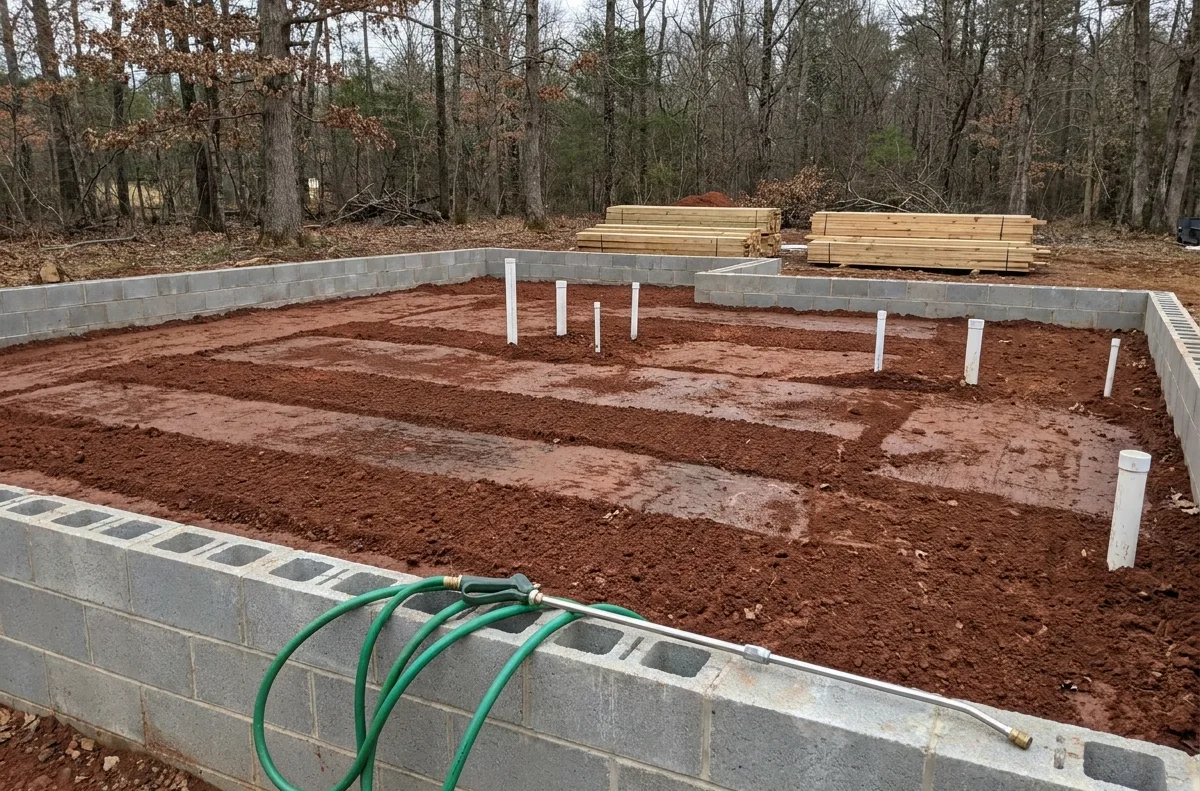
On a new build we normally make two trips. The first comes after the plumber has set the under-slab lines and the fill is graded and compacted, and before the plastic goes down. The whole pad is treated evenly, with extra attention where pipes come up through the soil and along the inside of the footing. The pour should follow soon after, so rain does not wash across open treated ground.
The second trip is at final grade. Once backfill and rough landscaping are finished, the soil against the outside of the foundation is treated to complete the envelope. If the excavator comes back afterward to regrade or the landscaper trenches for irrigation, that stretch needs to be redone, so tell us.
- We give the builder a treatment record showing the date, product, dilution and volume applied, for the closing file.
- Porches, stoops and attached garage slabs are treated as part of the same job, because those are the spots where gaps usually get left.
- For an addition, the new footing is tied into whatever protection the original house has, and the old wall where the two meet is inspected first.
Installing a barrier on a house that is already standing
With the building in the way, the work is done from the edges. Soil is trenched beside the foundation and treated down toward the footing. Concrete that touches the house is drilled at regular intervals and the ground beneath it is injected. Hollow block foundations, common in mid-century houses along Rio Road and in Greenbrier, are treated through the voids as well, because termites climb inside the block where no one can see a tube.
The goal is the same as on new work: no break in the band. The usual places a barrier fails are the ones that were skipped, such as behind an air-conditioning pad, under a set of steps, or where a deck ledger covers the foundation.
How long a barrier lasts
Modern soil products are generally labelled for several years of protection, and how they hold up depends on the soil and on what happens to it. Dense clay holds a treatment well. Digging does not: a new patio, a French drain or a row of foundation shrubs can all open a gap. That is the main reason an annual look is written into our agreements, and why physical barriers, which do not wear out in the same way, are worth considering while a house is still under construction.
For builders: we schedule around your pour, not the other way round. A day or two of notice is normally enough, and we would rather come out twice than treat ground that is going to be regraded.
If termites are already active in the house, the starting point is termite treatment rather than prevention. Owners who prefer something that can be checked from above ground often look at bait stations as well.